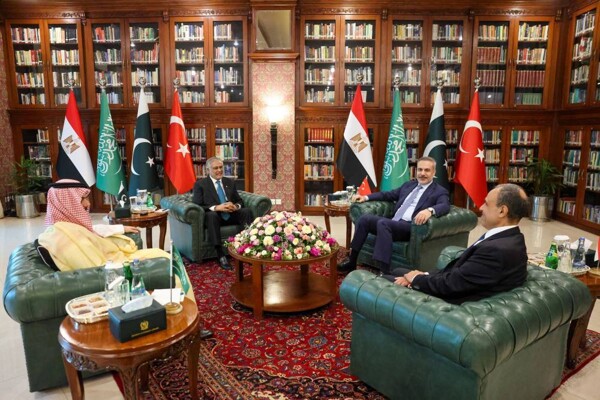
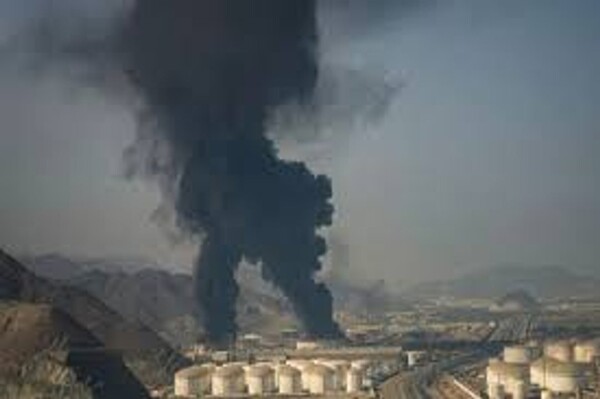
The group stated it would continue its operations until U.S. and Israeli attacks against the Islamic Republic and its allied militant groups, including Hezbollah in Lebanon, cease. While the Houthis did not explicitly say they would attack tankers or other vessels transiting the southern Red Sea and the Bab el-Mandeb strait, they effectively closed the maritime route to most Western carriers after the Gaza war began in 2023. For now, the Houthis will likely avoid attacking Saudi oil facilities, according to New York-based political consultancy Eurasia Group in a note to its clients. Attacks in the Middle East conflict entered a fifth consecutive week on Sunday, with an Israeli strike on Tehran and Saudi Arabia intercepting nearly a dozen drones, a day after Yemen-based Houthi militants entered the war. The attacks came as 3,500 additional U.S. troops were arriving and regional powers like Saudi Arabia and Turkey met in Pakistan to discuss how to end the conflict, which has killed thousands and thrown commodity markets and global trade into chaos. Pakistan's Foreign Minister Ishaq Dar said after meeting with his counterparts from Turkey, Egypt, and Saudi Arabia that “both Iran and the United States have expressed confidence in Pakistan” to host future talks, though neither side has indicated a willingness to meet. ‘Appears’ Mojtaba Khamenei. Iran's Supreme Leader, Mojtaba Khamenei, made statements on Saturday, his first in about a week, thanking Iraqi religious authorities for their support in the war, according to state-run Hamshahri newspaper. Khamenei, who became the country's Supreme Leader after his father, Ayatollah Ali Khamenei, was assassinated in the early hours of the war, has yet to be seen in public since his appointment, and the U.S. claims he is injured, possibly severely. Iran-backed Houthis launched ballistic missiles at Israel on the morning of Saturday, March 28, following joint U.S.-Israeli strikes on Iranian nuclear facilities. Tehran also attacked aluminum producers in Bahrain and the United Arab Emirates, as well as a U.S. base in Saudi Arabia, injuring more than a dozen U.S. service members. According to The Washington Post, the U.S. Department of Defense was preparing for possible weeks of ground operations in Iran, citing unnamed U.S. officials. Any mission would likely primarily aim to open the Strait of Hormuz, the strategic waterway through which a fifth of the world's seaborne oil was transported before the war but whose flow has now been drastically reduced, causing the largest supply disruption in the history of the global oil market. “Our men are waiting for the American soldiers to land,” said Iranian Parliament Speaker Mohammad Bagher Ghalibaf, according to the semi-official news agency Tasnim. The Importance of the Strait of Hormuz. The Strait of Hormuz has become Iran's main card in the war, and Tehran is drafting a law to regulate transit through the waterway. It will include sections related to maritime security, fee collection, and the creation of a “fund for development and regional progress,” according to statements by lawmaker Alireza Salimi cited on Sunday by the semi-official Fars news agency. “What the Iranians are actually doing is declaring war on the world economy,” said Daniel Yergin, vice president of S&P Global, on Fox News' Sunday Morning Futures. “They are trying to turn the Strait of Hormuz, an international waterway, into basically an Iranian canal that they can control and extract money from.” Pakistan announced a deal with Tehran on Saturday to allow passage for 20 of its vessels, while Bahrain announced a ban on nighttime navigation for fishing and recreational boats on Sunday, citing the Iranian threat. Militant Islamists agreed to a ceasefire with Saudi Arabia in 2022, which has largely held. Saudi Arabia has managed to reroute some of its oil to avoid the strait, and its East-West pipeline is now operating at full capacity of 7 million barrels per day, according to a source close to the matter. How will the Houthis interfere? The Houthis could complicate the situation: the port of Yanbu, on the Red Sea, through which 5 million barrels of Saudi exports currently pass, is within their missile range.

Iran and Allies Threaten Global Economy by Closing Strait of Hormuz
Iran, backed by Houthis and Hezbollah, threatens a key global oil shipping route, causing trade chaos. As the U.S. and Israel prepare for potential ground operations, regional powers seek ways to de-escalate a conflict that has already caused numerous casualties.