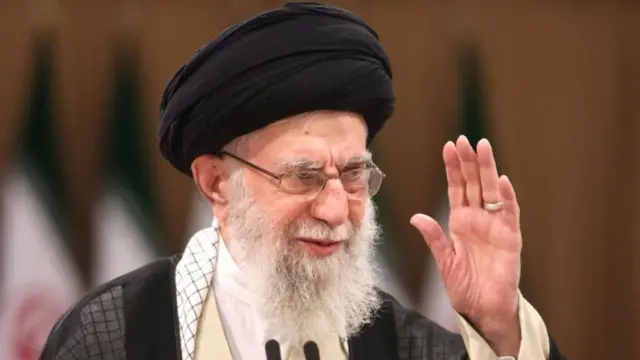
Tehran, January 24, 2026 – Total News Agency-TNA – Iran's Supreme Leader, Ayatollah Ali Khamenei, has reportedly been moved to a high-security underground shelter on the outskirts of Tehran amid the marked deterioration of the regional strategic climate and the growing possibility of direct military action against the Islamic regime. In this context, the security of the supreme leader has become a strategic priority. Diplomatic sources cited by the international press maintain that the move is not merely preventive but a clear signal that the regime interprets the confrontation to already be in an advanced, though undeclared, phase. The leader's retreat underground reinforces the perception that Tehran is preparing for a scenario of open war or high-impact selective attacks. In parallel, unusual movements were registered within the Iranian state apparatus. The decision is said to have been taken following new warnings from the United States and Israel, coupled with the unusual deployment of U.S. military assets in the Middle East, including naval carrier groups and defensive reinforcements at regional bases. Some executive and political coordination functions appear to have been informally delegated to an extremely small circle of trust headed by his son, fueling speculation about a more closed and militarized command structure. Although the Iranian government has not officially confirmed the information, multiple coinciding reports from international media and intelligence assessments point to the measure being a response to a risk scenario considered 'critical' by the power echelon in Tehran. According to the versions being circulated, Khamenei would be protected in a fortified complex designed to withstand aerial and high-precision missile attacks. For critical sectors of the regime, this confirms the real vulnerability of Iranian power in the face of Western military capabilities. Iranian lawmakers and regime spokespersons issued harsh warnings to the outside, stating that any attack on Khamenei would be interpreted as a declaration of total war, with unpredictable regional consequences. The immediate precedent for this type of measure dates back to previous episodes of maximum tension, when the Iranian leadership opted for underground confinement amid credible threats of aerial attacks. Beyond the lack of official confirmation, the implicit message is unequivocal: the regime is preparing for an extreme scenario in which the survival of its leadership is no longer taken for granted. For the hardest sectors of the establishment, on the other hand, it reinforces the narrative of resistance and victimhood, which could be used to justify an internal repressive escalation or indirect military actions through regional allies. On the international front, the situation is being followed with extreme attention by governments and markets. An eventual attack on Iranian strategic targets, or a Tehran response against U.S. or Israeli interests, could unleash a large-scale conflict in the Middle East, with a direct impact on oil prices, trade routes, and regional political stability. For now, Khamenei's presence in an underground shelter appears as one of the clearest indications that Iran feels under an existential threat. However, analysts agree that the current context is significantly more serious: the combination of military pressure, persistent economic sanctions, diplomatic isolation, and internal protests has reduced the regime's room for maneuver.