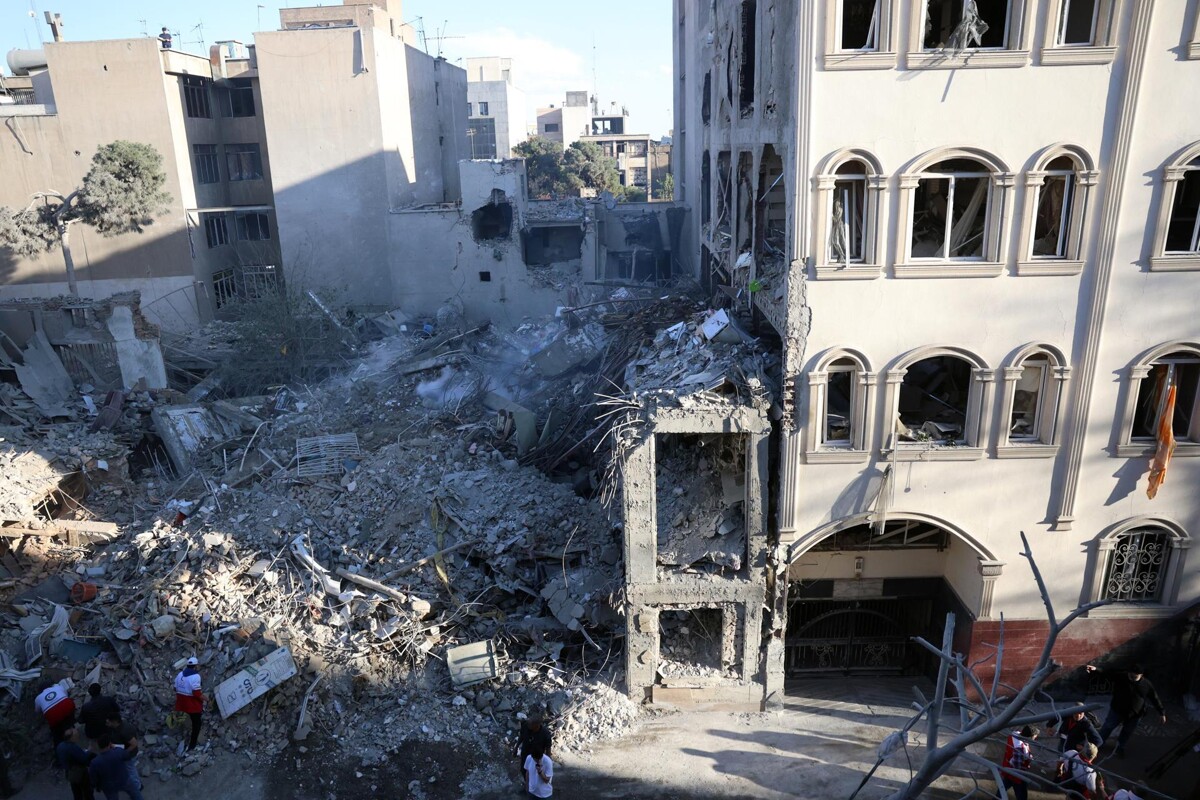
As the deadline set by U.S. President Donald Trump for Iran to accept a ceasefire agreement approaches, the most hardline sectors now in power in Tehran are delighting in the idea of an escalation and a conflict across the entire region. The United States and Israel have eliminated several high-ranking commanders of the Islamic Revolutionary Guard Corps during the nearly six weeks of war, but those remaining are preparing for a prolonged battle, with no fear of Trump's threats to destroy civilian infrastructure. This could trigger a resumption of fighting that would involve even more Middle Eastern countries and worsen the global energy crisis. An Iraqi militia linked to the Islamic Revolutionary Guard warned on Tuesday in its Telegram channel that if Trump follows through on his threat to completely annihilate Iran, it would attack the port of Yanbu on the Red Sea to “plunge the world into an energy war.” Saudi Arabia has been using the Yanbu terminal to export nearly 5 million barrels of oil per day to bypass Iran's blockade of the strategic Strait of Hormuz. “The group of people who are institutionally and personally committed to the resilience and survival of the regime now hold command and control,” stated Sanam Vakil, director of the Middle East and North Africa program at London-based Chatham House. “It will be difficult to convince them that it is time to negotiate, and that is why the terms and conditions that Iran continues to put on the table are so maximalist.” What are Iran's demands to end the war? Iran's demands include: Guarantees that it will not be attacked again by the U.S. and Israel. The right to control the Strait of Hormuz. The lifting of long-standing economic sanctions. What are Trump's demands to end the war? Trump wants Tehran to: Reopen the strait. Abandon its nuclear program. End its support for affiliated militant groups. Accept restrictions on its missile program. Vakil stated that Iran's most radical faction does not want to concede too soon, while the weaker reformist group is “seeking an exit” because it believes Tehran now has significant influence thanks to its control of Hormuz. It is becoming increasingly clear that Iranian leaders, such as President Masoud Pezeshkian and Foreign Minister Abbas Araghchi, who might be more open to a deal with Trump, do not fully understand what is happening on the military front, said a European official whose government remains in contact with them and who requested anonymity to speak freely. It is unlikely that Trump's threats to destroy civilian infrastructure, including water and energy facilities—which could be war crimes under international law—will influence the regime, stated Karim Sadjadpour, a senior researcher at the Carnegie Foundation, in a series of posts on X on Monday. “His threats to devastate Iran have not moved a regime that, from its inception, has shown itself willing to destroy the country and its people rather than compromise its power or ideology,” he wrote. Iran, Fearless of a Long War. The idea that Iran is prepared for a long war, at any cost, has dominated the messaging of recent days, both from within Iran and from its allies in Iraq and Lebanon. “Hormuz will become inaccessible to the enemies, and let them know that if they intend to take it by force, no oil and gas terminals will be left,” stated on Monday Abu Hussein Al-Hamidawi, commander of the Hezbollah Brigades militia, backed by the Islamic Revolutionary Guard in Iraq. Naim Qasem, leader of Hezbollah in Lebanon, urged the Lebanese people to prepare for a prolonged battle and greater sacrifices. A message spread last week by Iranian state media on social media, attributed to Esmail Qaani, commander of the Islamic Revolutionary Guard Corps unit known as the Quds Force, said: “Get used to the new regional order.” He spoke of a “unified command center” with affiliated groups, including the Houthis of Yemen. “For Iran's most hardline sectors, the longer the war drags on, the worse the Americans will look,” stated Matthew Levitt, an expert on Iran and its allies, and director of the counterterrorism program at the Washington Institute. Iran is also increasingly warning Gulf states that their security alliances with the U.S. and the hosting of U.S. bases represent a burden. “The bases that the enemy has established in your countries are not only used to attack us, but are also hotbeds of sowing discord and division among Muslim nations,” stated on Sunday on Iranian state television Mohammad Reza Mavalizadeh, governor of Iran's southwestern Khuzestan province, addressing the Gulf's Arab leaders. But that strategy is already showing signs of backfiring. In the wealthy Gulf states, despite their frustration with the war, Iran's aggression is bringing them closer to the U.S., and in the case of the UAE, even to Israel. “Our main security partner is the United States; we will redouble our efforts to strengthen our relationship,” stated on Saturday to reporters Anwar Gargash, diplomatic adviser to UAE President Sheikh Mohamed bin Zayed.