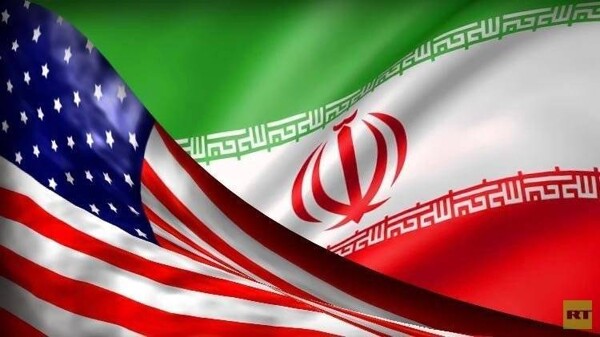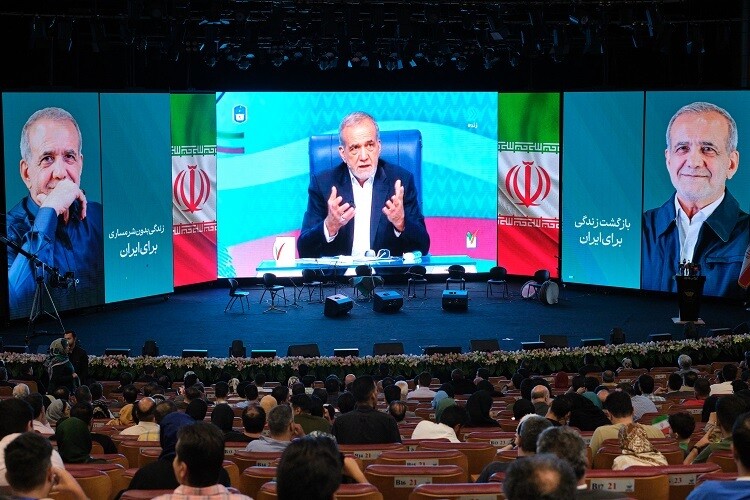
Iran secured on Sunday that it takes orders from no one and does not accept the domination of great powers, in reference to the United States and its demand for zero uranium enrichment, two days after resuming indirect nuclear negotiations in Muscat, Oman.
“We are not seeking a nuclear bomb, our bomb is the power to say no to the great powers,” stated Iranian Foreign Minister Abbas Araghchi at the first National Congress on Foreign Policy and its History, according to IRNA agency.
Araghchi highlighted that Iran's atomic program has been a national necessity, especially in areas such as agriculture, health, and future nuclear fuel needs, so it cannot renounce it.
The head of Iranian diplomacy added that Tehran has paid a high price to have a peaceful nuclear program and exercise its right to enrich uranium, which he considered “indisputable.”
“We will not renounce our right to enrich uranium, even if the cost is high. No one has the right to tell us what we must have,” stated Araghchi two days after resuming indirect nuclear negotiations with the United States in Muscat, Oman.
However, the chief Iranian negotiator once again stated that the Islamic Republic is willing to dispel concerns about the Iranian nuclear program “transparently and build trust” through diplomacy, while at the same time warning that they will respond to any military action.
“The increase in the U.S. military presence does not intimidate us. We are ready for war, but we are not warmongers. If they choose diplomacy, we will follow that path,” he emphasized.
Iran's President, Masoud Pezeshkian, described the holding of nuclear negotiations between his country and the United States on Friday as “a step forward,” but reiterated that Tehran will not renounce peaceful uranium enrichment, considering it its right as a signatory to the Nuclear Non-Proliferation Treaty (NPT).
“These dialogues were a step forward. Dialogue has always been our strategy to resolve issues peacefully,” stated Pezeshkian in a message on the social network X.
The negotiations between Iran and the U.S. take place at one of the lowest points for the Islamic Republic, following the most violent protests since its founding in 1979, which occurred in January, and after Trump's threats to intervene militarily in Iran if an agreement was not reached or if the lethal repression of protesters continued.
For this, he has deployed the USS Abraham Lincoln aircraft carrier and its battle group near Iranian waters in the Persian Gulf.
Protests in Iran began at the end of December due to the fall of the rial, but soon spread across the country calling for the end of the Islamic Republic and ended in a repression in which Tehran recognizes 3,117 dead.
However, opposition organizations such as HRANA, based in the United States, place the death toll at 6,961, although they continue to verify more than 11,600 possible deaths, as well as 51,000 arrests.
The UN Special Rapporteur for Iran, Japanese national Mai Sato, has told U.S. media that reports from doctors inside Iran indicated that up to 20,000 deaths may have occurred due to the repression, although, according to the United Nations, these figures remain difficult to corroborate.