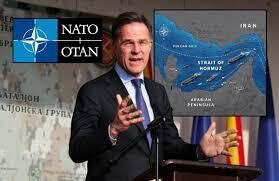
Since Iran began restricting transit, hundreds of ships have been immobilized or rerouted, thousands of sailors have been trapped in the region, and the energy market has re-entered crisis mode. The impact is already being felt on crude oil, gas, and maritime shipping prices, and threatens to spill over into inflation, interest rates, and production costs in Europe, Asia, and America. In this context, Rutte's announcement is also supported by a previous diplomatic sequence. One thing is to sign statements, condemn Iran, and support the reopening of the passage; another very different thing is to commit naval forces, assume military risks, and participate in a mission in an area where the Iranian regime has already demonstrated its ability to mine routes, harass ships, and hit critical infrastructure. For now, the Secretary General has avoided speaking of an operation already launched and has limited himself to indicating that the capitals involved are working on possible scenarios, timings, and forms of action, while the military campaign against Iran remains open and the risk of regional escalation persists. The step taken, despite all that caution, has political importance for two reasons. First, because it shows that the pressure from Donald Trump on his allies has begun to take effect. The novelty now is that this sum of scattered support is beginning to turn into a more concrete coordination, with a defined number of countries willing to work on an operational solution. Anyway, the picture is still loaded with uncertainty. What is still not defined is the when, the how, and the exact scope of that eventual intervention. If the coalition manages to move from diagnosis to action, the Iranian regime will have achieved exactly the opposite of what it sought: to unite a broad bloc of countries around the need to take away its control of the world's main energy bottleneck. The G7 has already expressed its support for security in the Strait of Hormuz and the protection of global energy supplies, while the European Union had days before called for the reopening of the strait and, with strong caution, backed the willingness of some states to contribute to freedom of navigation. That is why, although Rutte's announcement represents a step forward, it still does not amount to an immediate solution. Second, because it reveals that the Iranian blockade of the Strait of Hormuz has ceased to be perceived as a problem exclusive to the Gulf or the war between Israel and Tehran: it has become a direct threat to global energy security, and therefore, to the economic stability of much of the world. The magnitude of the problem explains the urgency. The coalition exists in formation, but its effective translation onto the water is still to be seen. What is clear is that the margin for passivity is shrinking. Iran has turned the Strait of Hormuz into a tool of geopolitical and energy pressure, and that decision has ended up forcing an international reaction that a week ago seemed distant. The Secretary General of NATO, Mark Rutte, confirmed that as of Thursday, a group of 22 countries, mostly members of the Atlantic alliance, is working with the United States to evaluate measures aimed at ensuring that the maritime passage becomes free for navigation as soon as possible. Normally, about a fifth of the world's crude oil and liquefied natural gas consumption passes through the Strait of Hormuz. If, on the other hand, the response is delayed again, the message that will remain standing will be another: that Tehran can still condition the West with threats, missiles, and maritime blackmail. In recent days, the US president has harshly criticized NATO, accused several partners of cowardice, and even stated that without the United States, the alliance is a 'paper tiger.' This definition marks a change in climate: after several days of hesitations, mutual recriminations, and European reticences, a broader coalition to face the partial blockade imposed by Iran on one of the planet's most sensitive energy arteries has begun to take shape. According to Rutte, to this core of NATO countries, Japan, South Korea, Australia, New Zealand, the United Arab Emirates, and Bahrain are also joining. Brussels/Washington, March 22, 2026 - Total News Agency - TNA - The Strait of Hormuz crisis has begun to push the West toward a more coordinated response.