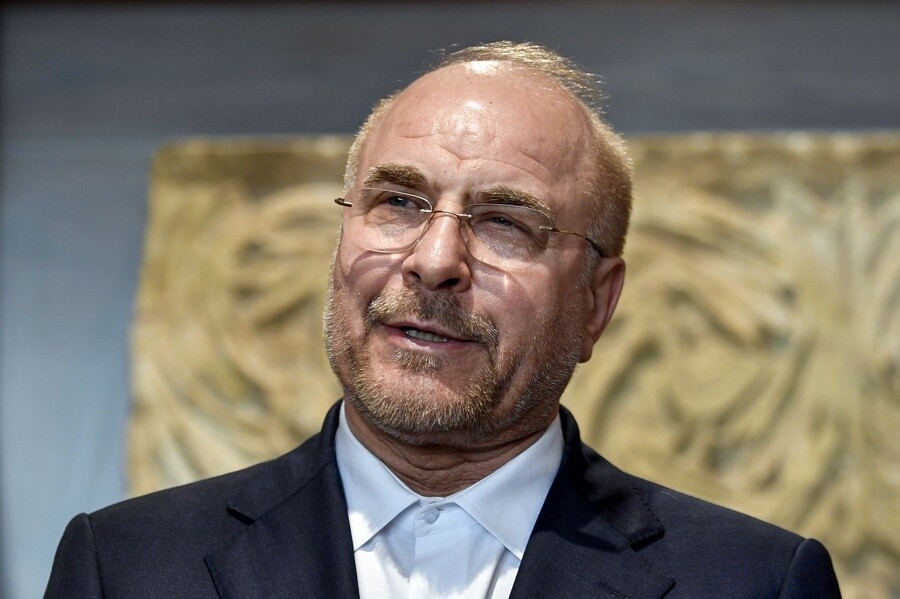
In recent weeks, he has maintained a high public profile, with numerous social media posts attacking the US president, Donald Trump, with a strong dose of irony and humor. His interventions carry more weight than those of Iran's president, Masoud Pezeshkian, who lacks a political support base. Qalibaf stands at the intersection of political and military power, after years as head of parliament and his past as a brigadier general in the Revolutionary Guard. He maintains close ties with the elite military corps, whose mission is to defend the Islamic Revolution and which also controls an economic empire. For years, he has tried to project an image of being close to the people, pragmatic, open to business, and willing to talk to the West. As mayor of Tehran from 2005 to 2017, he would ride around the capital on a motorcycle, wearing aviator glasses and a leather jacket. A former Revolutionary Guard general, former police chief, and perpetual presidential candidate, Mohamad Baqer Qalaf has been at the forefront of Iranian politics for decades, and now, following the killing of numerous high-ranking officials by the United States and Israel, he is the most powerful man in the Islamic Republic of Iran. Proof of this is that he leads the Iranian delegation meeting this Saturday with US representatives led by Vice President J.D. Vance in Islamabad, where they will seek a way out of a war that threatens to further destabilize the Middle East and plunge the global economy into recession. Considered a pragmatic conservative and good manager, Qalibaf has been the speaker of parliament since 2020, but in Iran, offices do not always reflect the power of political figures. And that is the case with this 64-year-old veteran of the Iran-Iraq war. He sees in Trump someone who can help him achieve what the late Supreme Leader Ali Khamenei denied him: the presidency or some equivalent interim leadership role." In 2008, he participated in the World Economic Forum in Davos and presented himself as a friendly face open to negotiation. But in Tehran, many remember him for the repression of the 1999 student protests and later as the country's police chief, when he carried out repressive campaigns and arrests of people related to culture and the media. This lack of connection with the population has been reflected in the fact that he has run for president four times — in 2005, 2013, 2017, and 2024 — and has not won any of them. In some of those campaigns, he was attacked with the claim that Iranians would not vote for those who "only know how to execute and imprison." Now he is the country's most important political figure, following the deaths in Israeli and US attacks of the Secretary of the Supreme National Security Council, Ali Larijani, and the Secretary of the Supreme Defense Council, Ali Shamkhani, among others. "Many Iranians despise Qalibaf; diplomats consider him pragmatic," wrote analyst Michael Rubin of the conservative American Enterprise Institute recently. "Those diplomats confuse pragmatism with opportunism. Qalibaf is a survivor."